

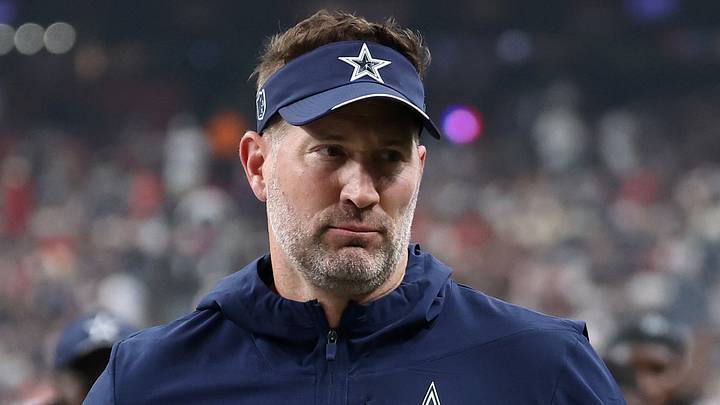
Can it get any worse than blowing a 24-10 fourth-quarter lead against one of the worst franchises in sports? Well, now that you ask (you didn't), a loss to the Colts might actually top it.
Indianapolis is in the midst of a fire sale after firing general manager Chris Ballard. They've lost four games in a row and have already traded star guard Quenton Nelson and standout defensive tackle DeForest Buckner. The Cowboys could sink lower this Sunday at Lucas Oil Stadium.
That might not be enough to get Brian Schottenheimer fired, however. The Cowboys have no immediate plans to move on from their head coach, meaning a decision on his future could wait until after the season.
Very few Cowboys fans need more convincing that Schottenheimer is unfit for the job, but Jerry Jones provided more proof in exposing Dallas' game plan against Arizona on 105.3 The Fan (h/t Joseph Hoyt, Dallas Morning News).
“We were playing a game to avoid turnovers the best we could," Jone said. "The game plan you saw was doing that. You can call that conservative if you want to. The game plan was based on us running the ball better than when we ran it. And when they did stack it really good … it’s certainly based on us giving [Dak Prescott] better protection.”
There is so much wrong there.
Brian Schottenheimer should be embarrassed by his game plan against the Cardinals
I'm not breaking any news by saying that Schottenheimer is a conservative (not elite) play-caller. It's arguably his biggest flaw. But his scared tendencies typically surface in certain situations, depending on the game script. The fact that his entire Week 8 game plan was built around playing not to lose takes that flaw to an entirely different level.
That would explain why the Cowboys ran the ball 39 times compared to 29 dropbacks. Schottenheimer seemingly didn't want to put the ball in Dak Prescott's hands, believing a risk-averse approach would be enough to beat an inferior Cardinals team.
That's delusional on multiple fronts.
Entering Week 8, the Cardinals' defense couldn't get out of its own way, ranking 29th in EPA per play, 21st in success rate and 31st in dropback EPA. If there's one area they excelled, though, it's against the run, as they ranked eighth in rush EPA from Weeks 1 to 7.
Schottenheimer's game plan ignored the possibility of Arizona stacking the box and bringing pressure all game -- a formula the Buccaneers and Packers had already used to great effect against Dallas. It's no wonder the Cowboys struggled to run the ball.
Sure, Javonte Williams looked like a back who had carried 25 times just six days earlier, and the offensive line struggled to pick up stunts and repeatedly allowed free runners into the backfield.
But those issues only compounded the bigger problem. Schottenheimer played right into the Cardinals' hands and stubbornly refused to adjust as his running game averaged 2.4 yards per carry. Is he even watching film during the week?
Schottenheimer's conservative tendencies will be his downfall
The schematic shortcomings are only half the problem. Schottenheimer's approach also ignored the very clear reality that Dallas has one of the worst defenses in football and cannot afford to play conservatively.
The Cowboys had a 3rd-and-20 at the end of the first half. Already in Brandon Aubrey's range, Schottenheimer called a give-up run and settled for a 61-yard field goal. Aubrey, who's been erratic from 60-plus yards this year, missed. In a game Dallas lost by three points.
The final drive of regulation was even worse.
The offense had 1st-and-10 at Arizona's 20 after Ryan Flournoy recovered an onside kick. Rather than try to kill the game with a touchdown, Schottenheimer played for a field goal as if he hadn't just watched his defense surrender touchdowns on three straight drives.
This has been going on for a season and a half now. The Cowboys' offense does not have the luxury of taking its foot off the gas. The mindset every week should be that Dallas needs to score 35 to 40 points to win. Yet Schottenheimer continues to coach as though avoiding mistakes is more important than scoring points.
Playing it safe is a luxury reserved for teams with defenses that can hold up their end of the bargain. Not one that routinely gets taken to school by backup quarterbacks and folds at the first sign of adversity.
Schottenheimer's approach was flawed from every angle. He designed a game plan that played to Arizona's strengths, refused to adjust when it wasn't working and repeatedly put the outcome in the hands of a defense that has given him no reason to trust it.
With each passing week, it becomes increasingly difficult to argue that this job isn't too big for him.
 Add us as a preferred source on Google