

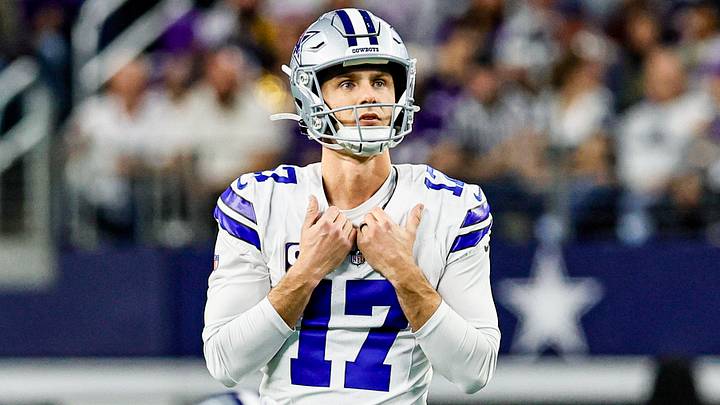
Brandon Aubrey is the NFL's best kicker. Even if other positional elites like Will Reichard and Cameron Dicker might outperform him within the unpredictable constraints of a single season, his year-to-year consistency and complete lack of weaknesses position him as the unquestioned gold standard.
But what exactly makes him so successful?
Aubrey's overall numbers are already remarkable. Over his three seasons with the Dallas Cowboys, he's knocked 113 of his 128 field-goal attempts through the uprights and gone 127-of-132 on extra points.
His 41.1-yard average make positions him as one of four kickers north of a 40-yard average on at least 50 successful conversions during that time frame, alongside Reichard (41.1 yards on 58 makes), Matt Prater (40.5 yards on 57 makes), and Joey Slye (40.3 yards on 73 makes).
Those numbers, even the more "advanced" ones like average make distance, don't come close to telling the full story. (That's pretty much the whole basis of my quest to take kicker analysis far deeper through my KVA metric and kick-charting efforts.)
Even the most cursory of peeks behind the curtain reveals that Aubrey's consistency from all distance ranges is his real secret sauce — and his mechanical superpower is the driving force behind it.
Brandon Aubrey has left all other kickers in the dust from long range
Does Aubrey have the strongest leg in the NFL? That's hard to quantify, and the answer isn't as definitive as his status as the best kicker.
Cam Little has made the two longest field goals in league history, drilling 67- and 68-yarders for the Jacksonville Jaguars last year (and a 70-yarder in preseason, to boot). Slye, Chase McLaughlin, Jake Bates, Tanner Brown, and Dominic Zvada, among others, are capable of Herculean feats with their dominant legs.
But Aubrey just...doesn't miss. At least, not often enough to negate the incredible volume of his long makes.
My proprietary kick value added (KVA) metric analyzes not just a kicker's makes and misses, but also the distances from which they kicked and the overall league's level of success from each area during the season in question. It provides a more accurate depiction of a kicker's impact than you'll find from the raw make/miss numbers.
Over the last three years, Aubrey has led the NFL in value added from 50-plus:
Kicker | KVA from 50-plus | Results from 50-plus | Average make distance |
|---|---|---|---|
Brandon Aubrey | +20.89 | 35-of-44 | 54.8 |
Chris Boswell | +20.06 | 28-of-33 | 53.9 |
Chase McLaughlin | +18.61 | 28-of-33 | 54.1 |
Ka'imi Fairbairn | +14.47 | 30-of-38 | 52.8 |
Nick Folk | +13.18 | 18-of-20 | 52.5 |
Making those numbers more remarkable? Aubrey was actually off his game in 2025, particularly at the end of the season. He pushed three deep kicks right in December, misfiring from 51 and 59 against the Minnesota Vikings and 58 against the Washington Commanders on Christmas Day. Then he followed that up with the rare miss to the left from 57 on Jan. 4.
Despite those foibles, he still tops the three-year leaderboard. Shrink the window to 2023 and 2024, and his 22.61 KVA on 50-plus kicks stands head and shoulders above Boswell's second-place 15.73.
But let's look at even longer kicks: the increasingly prevalent 60-plus attempts.
Kicker | KVA from 60-plus | Results from 60-plus | Average make distance |
|---|---|---|---|
Brandon Aubrey | +3.56 | 6-of-9 | 62.2 |
Cam Little | +2.63 | 2-of-2 | 67.5 |
Tyler Bass | +1.50 | 1-of-1 | 61.0 |
Matt Prater | +1.29 | 1-of-1 | 62.0 |
Chase McLaughlin | +1.24 | 1-of-1 | 65.0 |
(As a quick housekeeping note: It's not incorrect that Prater and McLaughlin earned less KVA than Bass for longer kicks; they made theirs in seasons that featured a higher-level league-average performance.)
Aubrey again paces the field since 2023 — expand the temporal range to include all of NFL history, and he falls behind only ex-Cowboy Brett Maher — but the volume stands out more this time around.
He's single-footedly taken nine kicks from 60-plus in the last three years while the rest of the league has gone 15-of-38. He alone has accounted for 28.6% of the NFL's 60-plus makes during the great distance explosion (and 11.3% in league history).
The 31-year-old obviously has a lot of power in that $28 million leg. But power alone doesn't imbue an organization with so much confidence that it considers a kicker within striking range as soon as he steps off the sidelines.
That level of belief, manifested both in the way the Cowboys talk about Aubrey and the number of times that count on him to risk terrible defensive field position for a shot at three points, stems from mechanical repeatability.
Brandon Aubrey's real superpower is his still upper body
Counterintuitive as this may seem, some elements of kicking are beyond the kicker's control. A long-snapper can put the ball off-target and create a split second of delay that leads to either a rushed or blocked attempt. A holder can fail to lean the ball slightly forward to create the necessary shear into a headwind or not tilt it fractionally to the side to create the side-spin on which the kicker is relying.
The kicker himself gets to focus on employing repeatable mechanics that reduce the margin for error. That looks different for everyone. Younghoe Koo begins with a setup that positions his hips parallel to the crossbar and requires late hip closure. Harrison Butker collapses his left knee at impact. The key isn't homogeneity of form, but consistency within a kicker's personal mechanics.
Aubrey accomplishes that better than everyone else by reducing the margin for error with a completely motionless upper body. You can read his nameplate throughout the kick. The 17 on his jersey is always legible.
From the right camera angle, he sometimes doesn't appear to move his helmet at all while addressing the ball, regardless of whether he's attempting a 30-yard chip shot or a 60-yard bomb.
Jaden Oberkrom, a former TCU kicker who's now the lead kicking instructor at the Dallas-area Oberkrom Kicking Academy, explained this quite well to WFAA back in October 2024.
To illustrate this, let's break down a pair of kicks, looking at the pre-kick setup, the approach to the ball, and the followthrough just after making contact.
An important caveat: The specific angles referenced should not be taken as gospel since they stem from hand-drawn annotations on game footage, which lacks the level of necessary precision. The overall trends still hold, but there's no meaningful difference between, say, shoulder tilts of 8.7 and 8.9 degrees.
The first kick is Aubrey's clutch 64-yarder against the New York Giants that sent the game to overtime and set the stage for his eventual 46-yard game-winner. The pressure and distance were both ratcheted up, but not to the point that they promoted any sort of mechanical breakdown. That simply isn't something about which Aubrey has to worry.

Nowhere does Aubrey show any hint of overswinging. Instead, even on the second-longest make of his career, he minimizes the movement of his upper body.
His head tilt, measured by looking at the crown of the helmet vs. the top-center of the shoulder pads, moves less than eight degrees (again, roughly). His shoulder orientation, as seen by the near-horizontal blue line, remains consistent through impact and levels out as his leg travels through its arc. His forward bend comes from a single hinge at the hip with his head, shoulders, and spine moving as one piece rather than his upper body rounding forward independently.
Compare that to a kicker who relies on an entirely different process to generate his increasingly legendary power: Cam Little.
We're not going to break down one of his record-setting kicks. Instead, we're taking the max-effort element out of the equation and highlighting a 48-yard boot that's very much within the Jaguars kicker's wheelhouse range.

The differences should be immediately visible to the naked eye.
You can see Little compressing his upper body, tilting his head toward the ball, and swiveling his shoulders enough that the "3" in his jersey number is nearly out of the frame in the early stages of his followthrough. The shoulders are held differently and don't fully level out the way Aubrey's do. His head tilt changes drastically throughout the attempt, swinging nearly 30 degrees.
While none of this is indicative of poor technique — Little's added torque through rotational freedom helps him deliver more raw power — it's a harder sequence to repeat on every pass. Aubrey even gets to his ideal body bend earlier in the process than Little, which creates more consistency through the ball. Put most simply: fewer things are in motion when he makes contact with the ball.
Again, so much of kicking is about minimizing the margin for error, and Aubrey has perfected that element of his craft.
 Add us as a preferred source on Google