

Two straight losses. One to a winless Buccaneers team at home. The other to a 3-2 Packers team at Lambeau Field that was much more lopsided than the 23-13 final score suggested. The offense has put up a combined 29 points in this stretch after averaging 30.5 points over the first four games.
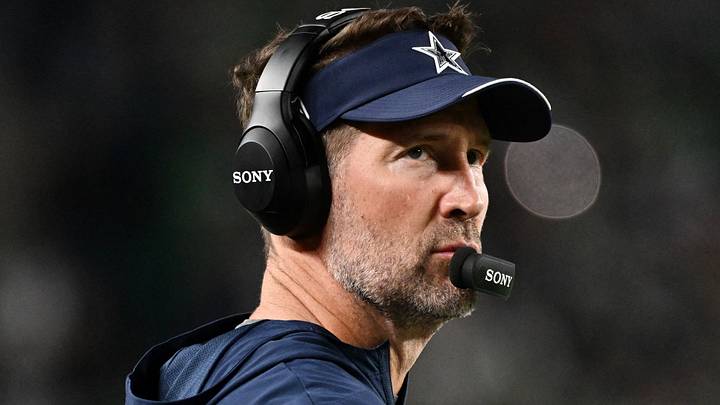
Nobody in Dallas had a bigger target on their back for the last week than Brian Schottenheimer. The Cowboys' backs were against the wall Monday night in Philadelphia, and they delivered to the tune of a 38-21 victory after pulling away in the fourth quarter.
The game followed a familiar script: The offense carried most of the water, and the defense, while incapable for large stretches, strung together a couple of key stops in the second half.
There were still a few head-scratching decisions along the way, but Schottenheimer was terrific against the Eagles. Most importantly, he made a host of long-overdue adjustments, both schematically and from a personnel standpoint, that helped unlock an offense that had been making life far too difficult on itself.
1. Schottenheimer remembered that Dallas has a good run game
It'd be revisionist history to say the Cowboys' rushing attack was humming early in the season before Schottenheimer got away from it in Weeks 5 and 6. It wasn't. You could feel Tyler Smith's absence, and while Javonte Williams was still creating yards in tight spaces, the offensive line left him with little room to operate.
As predictable as it was that Schottenheimer would re-commit to the run game on Monday, the extent to which he rode it was eye-opening.
Williams toted the rock 25 times for a career-high 125 yards. Those 25 carries were his most as a Cowboy and marked just the fourth time with Dallas that he's received at least 20 handoffs in a game.
Despite having a healthy Jordan Davis and Jalen Carter, the Eagles had no answers. The Cowboys averaged a whopping 2.45 yards before contact per carry. Their 0.199 rush EPA was the third-best of any team in Week 7, while their 48.6 percent rushing success rate was eighth-best.
It's not going to be that easy every week, but it was a timely reminder that Dallas can have a top-10 rushing attack.
Schottenheimer deserves credit for sticking to it throughout the game despite not having a comfortable lead until midway through the fourth quarter. It's clear he heard the criticism after the Cowboys rushed just once over their final 38 plays against the Packers.
2. Schottenheimer finally unleashed Tyler Goodson
How long have Cowboys fans been begging Schottenheimer to feature another running back alongside Javonte Williams? Pretty much since Emari Demercado opened the season as the clear RB2.
Tyler Goodson finally overtook Demercado in Week 3 and carried six times for 22 yards in his debut. Instead of building on that, Schottenheimer gave Goodson just five touches over the next three games.
Monday night was a different story, as Goodson carried 10 times for 38 yards. Not crazy efficient, but his explosiveness was impossible to miss. He has a gear that Williams can't reach, which makes him an ideal injection into the backfield.
Twenty-five carries is a hefty workload for any running back, but it's hard to argue that Goodson's involvement didn't help keep Williams fresh.
This might have been Williams' best game as a Cowboy, and it's hard to ignore that it came on the same night Dallas finally made a concerted effort to feature another runner alongside him.
There are too many benefits to mixing in another RB to make Goodson an afterthought again.
3. Less shotgun, more under center
A lot of good can come from operating out of the shotgun. It opens up RPO flexibility and gives the quarterback more time and space against pressure. But Dallas had become far too reliant on it in recent weeks, which speaks to their lack of preparation for the blitz.
The negatives far outweigh the positives when an offense becomes overly dependent on shotgun. Operating under center, on the other hand, creates more convincing play-action, allows the offensive line to fire off the ball and play downhill, and makes it easier to marry the run and pass, which is the key to any good offense.
Schottenheimer got back to what made last season's offense so successful. Per Sūmer Sports, Dallas was in the shotgun 47.7 percent of the time (almost 10 percent below league average) against Philly, compared to 52.3 percent under center (over 12 percent above league average).
In Week 6, the Cowboys were in shotgun on 74.3 of their snaps. They were under center 24.3 percent of the time. It's no wonder the offense couldn't find rhythm if it were in a jazz club.
The formula is simple: less shotgun, more under center and prosper.
4. Continued decrease in Jake Ferguson's role
This has been in motion for weeks after Ferguson's nightmare game against the Ravens in Week 3, but Monday was the first game I didn't even notice the veteran tight end. Here's how the tight end snaps looked:
- Jake Ferguson - 38 snaps
- Brevyn Spann-Ford - 36 snaps
- Luke Schoonmaker - 11 snaps
Spann-Ford caught both of his targets for 11 yards, while Ferguson failed to reel in his only look. More telling than the box score, though, is how their roles have evolved. Spann-Ford has become the preferred target on bootlegs when the tight end slips into the flat, and Ferguson isn't out there as often as a run-blocker.
Little by little, Schottenheimer is trusting BSF with more of the responsibilities that once belonged to Ferguson, and with good reason, as Dak Prescott has a higher success rate this season targeting Spann-Ford (53.8 percent) than Ferguson (40.0 percent). Spann-Ford hasn't been targeted as much, but we don't have to go into how detrimental Ferguson has been to the offense.
It feels like a matter of time before Spann-Ford logs more snaps than Ferguson.
5. Increased motion usage
What makes me think Schottenheimer read the criticism stemming from the Week 6 loss was the Cowboys' first drive. You saw everything that didn't happen against the Packers: A commitment to the ground game, more under-center looks, and an uptick in pre-snap motion.
Here's a breakdown of those splits from the last two weeks (via Sūmer Sports):
Week 6 | Week 7 |
|---|---|
70 offensive plays | 65 offensive plays |
25 plays with motion | 32 plays with motion |
35.7 percent motion rate | 49.2 percent motion rate |
Even more telling? Schottenheimer really tapped the motion vein in the run game: 19 times compared to five times last week. And for what it's worth, he used motion on 14 of 28 dropbacks against the Eagles, compared to 20 out of 52 dropbacks in Week 6.
Entering Week 7, the Cowboys ranked last in motion rate after ranking 13th in the same category last season. It is one of the easier levers an offensive play-caller can pull.
Like the other changes, it better be here to stay.
 Add us as a preferred source on Google